



Pilots, game designers, and electrical engineers all rely on the same three ideas. A vector packages a size and a direction into one object. Polar coordinates locate a point by how far it is and which way to look. Complex numbers in polar form turn rotation and scaling into simple multiplication. In this chapter you will connect all three and use them to solve real problems.
1. Vectors: magnitude and direction
A vector in the plane is written in component form as \(\mathbf{v}=\langle a,b\rangle\). Its magnitude (length) is \(\|\mathbf{v}\|=\sqrt{a^2+b^2}\). Its direction angle \(\theta\) is measured counterclockwise from the positive \(x\)-axis and satisfies \(\tan\theta=\dfrac{b}{a}\) when \(a\neq 0\).
Conversely, a vector with magnitude \(m\) and direction angle \(\theta\) has components \(\langle m\cos\theta,\ m\sin\theta\rangle\). The calculator’s inverse tangent only returns angles between \(-90^\circ\) and \(90^\circ\), so you must always check which quadrant the vector points into.
Find the magnitude and direction angle of \(\mathbf{u}=\langle -6,\ 6\sqrt{3}\rangle\).
\(\|\mathbf{u}\|=\sqrt{36+108}=\sqrt{144}=12\). Then \(\tan\theta=\dfrac{6\sqrt3}{-6}=-\sqrt3\), so the reference angle is \(60^\circ\). The vector points left and up (quadrant II), so \(\theta=180^\circ-60^\circ=120^\circ\). Answer: magnitude 12, direction \(120^\circ\).
2. Vector operations
Vectors are added and subtracted component by component, and multiplied by a number (a scalar) the same way: \(\langle a,b\rangle+\langle c,d\rangle=\langle a+c,\ b+d\rangle\) and \(k\langle a,b\rangle=\langle ka,\ kb\rangle\). Geometrically, you add two vectors by placing them tip to tail; the sum is the diagonal of the parallelogram they form. Multiplying by \(k\) stretches the vector by the factor \(|k|\) and reverses it when \(k<0\).
A unit vector has magnitude 1. To get the unit vector in the direction of \(\mathbf{v}\), divide by the magnitude: \(\hat{\mathbf{v}}=\dfrac{\mathbf{v}}{\|\mathbf{v}\|}\). The vectors \(\mathbf{i}=\langle1,0\rangle\) and \(\mathbf{j}=\langle0,1\rangle\) let you write \(\langle a,b\rangle=a\mathbf{i}+b\mathbf{j}\).
Let \(\mathbf{u}=\langle 2,5\rangle\) and \(\mathbf{v}=\langle -3,1\rangle\). Then \(2\mathbf{u}-3\mathbf{v}=\langle 4,10\rangle-\langle -9,3\rangle=\langle 13,\ 7\rangle\). The unit vector along \(\langle 3,4\rangle\) is \(\dfrac{1}{5}\langle 3,4\rangle=\langle 0.6,\ 0.8\rangle\).
3. The dot product
For \(\mathbf{a}=\langle a_1,a_2\rangle\) and \(\mathbf{b}=\langle b_1,b_2\rangle\), \(\mathbf{a}\cdot\mathbf{b}=a_1b_1+a_2b_2=\|\mathbf{a}\|\,\|\mathbf{b}\|\cos\theta\), where \(\theta\) is the angle between the vectors (\(0^\circ\le\theta\le180^\circ\)).
\(\cos\theta=\dfrac{\mathbf{a}\cdot\mathbf{b}}{\|\mathbf{a}\|\,\|\mathbf{b}\|}\). Two nonzero vectors are perpendicular exactly when \(\mathbf{a}\cdot\mathbf{b}=0\). The projection of \(\mathbf{a}\) onto \(\mathbf{b}\) is \(\operatorname{proj}_{\mathbf{b}}\mathbf{a}=\dfrac{\mathbf{a}\cdot\mathbf{b}}{\|\mathbf{b}\|^2}\,\mathbf{b}\). In physics, the work done by a constant force \(\mathbf{F}\) over a displacement \(\mathbf{d}\) is \(W=\mathbf{F}\cdot\mathbf{d}\).
With \(\mathbf{u}=\langle 2,5\rangle\) and \(\mathbf{v}=\langle -3,1\rangle\): \(\mathbf{u}\cdot\mathbf{v}=-6+5=-1\), \(\|\mathbf{u}\|=\sqrt{29}\), \(\|\mathbf{v}\|=\sqrt{10}\). So \(\cos\theta=\dfrac{-1}{\sqrt{290}}\approx-0.0587\) and \(\theta\approx 93.4^\circ\): the vectors are almost, but not quite, perpendicular.
The dot product of two vectors is a number, not a vector. Also, \(\|\mathbf{a}+\mathbf{b}\|\) is usually smaller than \(\|\mathbf{a}\|+\|\mathbf{b}\|\); the two are equal only when the vectors point the same way.
4. Polar coordinates and conversions
A point \(P\) is described by \((r,\theta)\): \(r\) is the signed distance from the origin (the pole) and \(\theta\) is the angle from the polar axis, the positive \(x\)-axis. A negative \(r\) means you walk backward, so \((-r,\theta)\) and \((r,\theta+\pi)\) name the same point.
Polar to rectangular: \(x=r\cos\theta,\ y=r\sin\theta\). Rectangular to polar: \(r^2=x^2+y^2\) and \(\tan\theta=\dfrac{y}{x}\), with \(\theta\) chosen in the correct quadrant.
Unlike rectangular coordinates, a point has infinitely many polar names: \((r,\theta)\), \((r,\theta+2\pi)\), \((-r,\theta+\pi)\), and so on. The pole itself is \((0,\theta)\) for any \(\theta\).
(a) \(\left(6,\dfrac{5\pi}{6}\right)\): \(x=6\cos150^\circ=-3\sqrt3\) and \(y=6\sin150^\circ=3\), so the point is \((-3\sqrt3,\ 3)\).
(b) \((-5,\ 5)\): \(r=\sqrt{25+25}=5\sqrt2\). The point is in quadrant II, so \(\theta=\dfrac{3\pi}{4}\). Answer: \(\left(5\sqrt2,\dfrac{3\pi}{4}\right)\).
5. Graphing polar curves
To graph \(r=f(\theta)\), build a table of values, plot each pair \((r,\theta)\), and connect the points in order of increasing \(\theta\). Symmetry saves work: if replacing \(\theta\) by \(-\theta\) leaves the equation unchanged, the graph is symmetric about the polar axis (the \(x\)-axis).
| Equation | Graph | Key facts |
|---|---|---|
| \(r=a\) | Circle | Centered at the pole, radius \(|a|\) |
| \(\theta=\alpha\) | Line | Through the pole at angle \(\alpha\) |
| \(r=2a\cos\theta\) | Circle | Center \((a,0)\), radius \(|a|\) |
| \(r=a\pm a\cos\theta\) | Cardioid | Heart shape, symmetric about the \(x\)-axis |
| \(r=a\cos n\theta\) or \(a\sin n\theta\) | Rose | \(n\) petals if \(n\) is odd, \(2n\) petals if \(n\) is even |
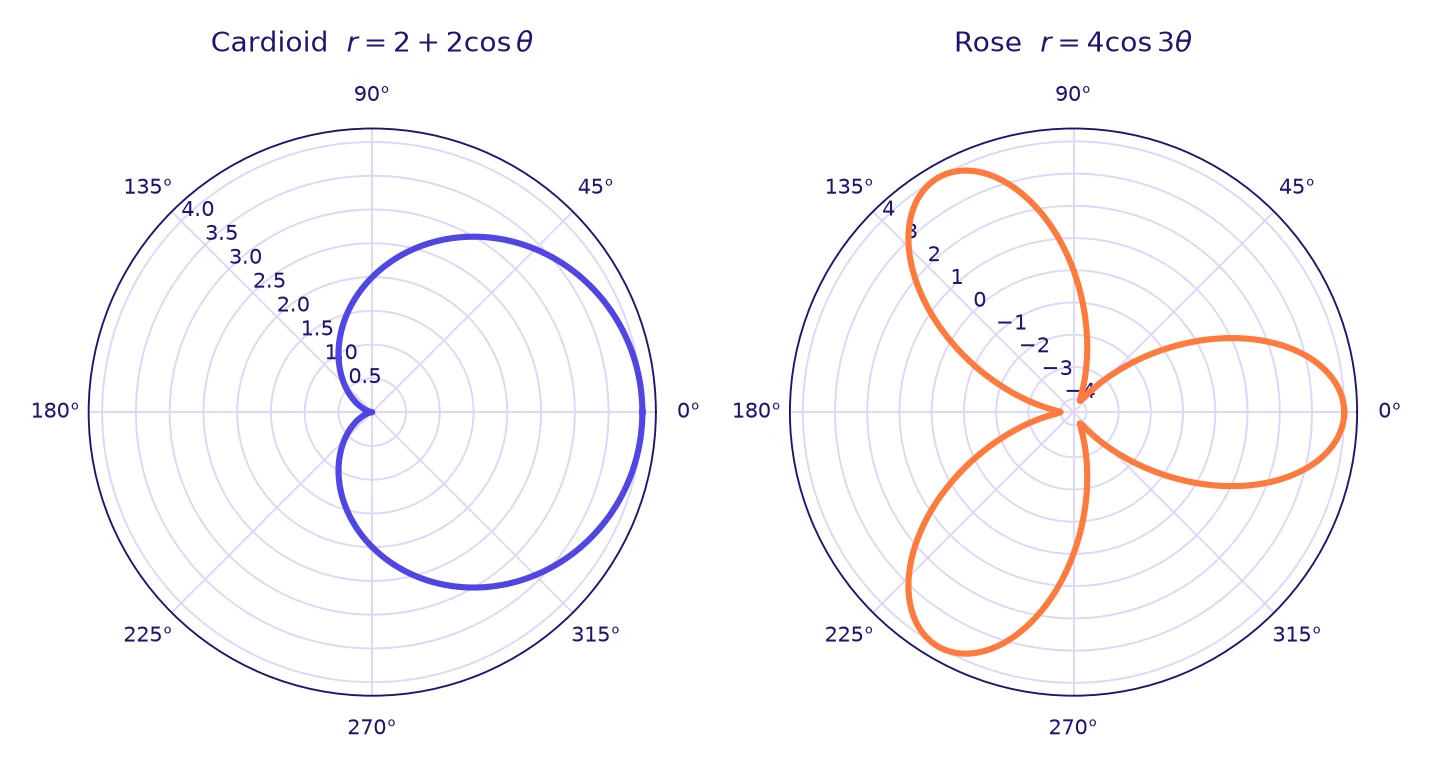
Graph \(r=2+2\cos\theta\) using a table.
| \(\theta\) | 0 | \(\pi/3\) | \(\pi/2\) | \(2\pi/3\) | \(\pi\) |
|---|---|---|---|---|---|
| \(\cos\theta\) | 1 | \(\tfrac12\) | 0 | \(-\tfrac12\) | -1 |
| \(r\) | 4 | 3 | 2 | 1 | 0 |
The curve starts 4 units to the right, shrinks to the pole at \(\theta=\pi\), and its lower half mirrors the upper half. It is the left graph below; the right graph is the three-petal rose \(r=4\cos3\theta\).
6. Complex numbers in polar form
A complex number \(z=a+bi\) is the point \((a,b)\) of the complex plane (real axis horizontal, imaginary axis vertical). Its modulus is \(|z|=r=\sqrt{a^2+b^2}\) and its argument \(\theta\) is the angle of the point, so \(a=r\cos\theta\) and \(b=r\sin\theta\).
\(z=r(\cos\theta+i\sin\theta)\), often abbreviated \(r\operatorname{cis}\theta\).
If \(z_1=r_1\operatorname{cis}\theta_1\) and \(z_2=r_2\operatorname{cis}\theta_2\), then \(z_1z_2=r_1r_2\operatorname{cis}(\theta_1+\theta_2)\) and \(\dfrac{z_1}{z_2}=\dfrac{r_1}{r_2}\operatorname{cis}(\theta_1-\theta_2)\). Multiply the moduli, add the arguments.
(a) For \(z=-1+i\sqrt3\): \(r=\sqrt{1+3}=2\), the point is in quadrant II with reference angle \(60^\circ\), so \(z=2\operatorname{cis}120^\circ\).
(b) \((3\operatorname{cis}40^\circ)(2\operatorname{cis}50^\circ)=6\operatorname{cis}90^\circ=6i\).
7. De Moivre’s Theorem
For every integer \(n\), \([r(\cos\theta+i\sin\theta)]^n=r^n(\cos n\theta+i\sin n\theta)\). Raising to a power means raising the modulus to that power and multiplying the argument by \(n\).
(a) \(1+i=\sqrt2\operatorname{cis}45^\circ\), so \((1+i)^8=(\sqrt2)^8\operatorname{cis}360^\circ=16\).
(b) \(\sqrt3-i=2\operatorname{cis}(-30^\circ)\), so \((\sqrt3-i)^6=2^6\operatorname{cis}(-180^\circ)=-64\).
A frequent slip is to multiply the argument by \(n\) but forget to raise the modulus to the power \(n\). Also reduce the final angle by multiples of \(360^\circ\) before reading off the answer.
8. Roots of complex numbers
A nonzero number \(z=r\operatorname{cis}\theta\) has exactly \(n\) distinct \(n\)th roots: \(z_k=r^{1/n}\operatorname{cis}\!\left(\dfrac{\theta+360^\circ k}{n}\right)\) for \(k=0,1,\dots,n-1\). They lie on a circle of radius \(r^{1/n}\) and are the vertices of a regular \(n\)-gon.
- Write \(z\) in polar form \(r\operatorname{cis}\theta\).
- Compute \(r^{1/n}\) and the first argument \(\theta/n\).
- Add \(360^\circ/n\) repeatedly to get the other arguments.
- Convert to \(a+bi\) if the problem asks for it.
\(8=8\operatorname{cis}0^\circ\), so the roots have modulus \(\sqrt[3]{8}=2\) and arguments \(0^\circ,120^\circ,240^\circ\): \(z_0=2\), \(z_1=-1+i\sqrt3\), \(z_2=-1-i\sqrt3\).
On my home planet we check roots by symmetry: the \(n\) roots are spread evenly around a circle, so they always add up to zero. If your sum is not zero, one root is wrong!
Key takeaways
- \(\|\langle a,b\rangle\|=\sqrt{a^2+b^2}\); the direction angle needs a quadrant check.
- Add vectors and multiply by scalars component by component; the dot product \(a_1b_1+a_2b_2\) is a number equal to \(\|\mathbf{a}\|\|\mathbf{b}\|\cos\theta\).
- Perpendicular vectors have dot product 0; work is \(W=\mathbf{F}\cdot\mathbf{d}\).
- \(x=r\cos\theta\), \(y=r\sin\theta\), \(r^2=x^2+y^2\); a point has many polar names.
- Rose \(r=a\cos n\theta\): \(n\) petals if \(n\) is odd, \(2n\) if \(n\) is even; cardioid \(r=a\pm a\cos\theta\).
- \(z=r\operatorname{cis}\theta\): multiply moduli and add arguments; De Moivre gives \(z^n=r^n\operatorname{cis}n\theta\).
- The \(n\) \(n\)th roots of \(z\) are equally spaced on a circle of radius \(r^{1/n}\).


Test yourself: quick challenge for Grade 12
Speed drill for Grade 12: how many in 60 seconds?
🚀 Keep exploring with Zyro
 ✏️ Math practiceVectors, Polar Coordinates, and Complex Numbers: math practice, Grade 12
 📝 Math testsVectors, Polar Coordinates, and Complex Numbers: math test, Grade 12
 🎯 Math quizzesVectors, Polar Coordinates, and Complex Numbers: math quiz, Grade 12
 ✏️ Math practiceConic Sections and Parametric Equations: math practice, Grade 12
 ✏️ Math practiceMatrices and Systems of Equations: math practice, Grade 12
 📝 Math testsConic Sections and Parametric Equations: math test, Grade 12