



Satellites orbit, Ferris wheels turn, sound waves repeat and a spinning drill bit cuts: all of these follow circles. In Grade 12 you move trigonometry off the triangle and onto the unit circle, where every angle, even a negative one or one bigger than a full turn, gets a sine, a cosine and a tangent. Let us build the whole picture step by step.
1. Radian measure and arc length
One radian is the measure of the central angle that cuts off an arc whose length equals the radius of the circle. Since a full circle has circumference \(2\pi r\), a full turn measures \(2\pi\) radians, so \(180^\circ = \pi\) radians.
- Degrees to radians: multiply by \(\dfrac{\pi}{180}\).
- Radians to degrees: multiply by \(\dfrac{180}{\pi}\).
On a circle of radius \(r\), a central angle \(\theta\) measured in radians intercepts an arc of length \(s = r\theta\) and bounds a sector of area \(A = \tfrac{1}{2}r^{2}\theta\).
A sector has radius \(6\text{ cm}\) and central angle \(\dfrac{\pi}{3}\). Then \(s = 6\cdot\dfrac{\pi}{3} = 2\pi \approx 6.28\text{ cm}\), which is about \(2.47\) inches.
\(225^\circ = 225\cdot\dfrac{\pi}{180} = \dfrac{5\pi}{4}\) and \(\dfrac{7\pi}{12}\text{ rad} = \dfrac{7\pi}{12}\cdot\dfrac{180}{\pi} = 105^\circ\).
The formula \(s = r\theta\) is only true when \(\theta\) is in radians. With degrees you must convert first.
2. The unit circle and its special values
The unit circle is the circle of radius 1 centered at the origin, with equation \(x^{2}+y^{2}=1\). Start at the point \((1,0)\) and travel along the circle through a signed angle \(\theta\) (counterclockwise is positive). The point you reach is \((\cos\theta,\ \sin\theta)\).
Because the point lies on the circle, the coordinates always satisfy \(\cos^{2}\theta+\sin^{2}\theta=1\). Memorize the first-quadrant values; every other special angle is a reflection of them.
| \(\theta\) | \(0\) | \(\dfrac{\pi}{6}\) | \(\dfrac{\pi}{4}\) | \(\dfrac{\pi}{3}\) | \(\dfrac{\pi}{2}\) |
|---|---|---|---|---|---|
| \(\sin\theta\) | \(0\) | \(\dfrac{1}{2}\) | \(\dfrac{\sqrt{2}}{2}\) | \(\dfrac{\sqrt{3}}{2}\) | \(1\) |
| \(\cos\theta\) | \(1\) | \(\dfrac{\sqrt{3}}{2}\) | \(\dfrac{\sqrt{2}}{2}\) | \(\dfrac{1}{2}\) | \(0\) |
| \(\tan\theta\) | \(0\) | \(\dfrac{\sqrt{3}}{3}\) | \(1\) | \(\sqrt{3}\) | undefined |
On my planet we write the sines as \(\dfrac{\sqrt{0}}{2},\dfrac{\sqrt{1}}{2},\dfrac{\sqrt{2}}{2},\dfrac{\sqrt{3}}{2},\dfrac{\sqrt{4}}{2}\) and the cosines in the opposite order. Nothing else to remember!
The sign of each coordinate depends on the quadrant:
| Quadrant | Angle range | \(\sin\) | \(\cos\) | \(\tan\) |
|---|---|---|---|---|
| I | \(0<\theta<\dfrac{\pi}{2}\) | + | + | + |
| II | \(\dfrac{\pi}{2}<\theta<\pi\) | + | − | − |
| III | \(\pi<\theta<\dfrac{3\pi}{2}\) | − | − | + |
| IV | \(\dfrac{3\pi}{2}<\theta<2\pi\) | − | + | − |
3. The six trigonometric functions
For the point \((x,y)=(\cos\theta,\sin\theta)\) on the unit circle:
\[\sin\theta=y,\quad \cos\theta=x,\quad \tan\theta=\dfrac{y}{x}=\dfrac{\sin\theta}{\cos\theta},\]
\[\csc\theta=\dfrac{1}{\sin\theta},\quad \sec\theta=\dfrac{1}{\cos\theta},\quad \cot\theta=\dfrac{\cos\theta}{\sin\theta}.\]
A function is undefined wherever its denominator is \(0\): \(\tan\) and \(\sec\) at \(\theta=\dfrac{\pi}{2}+k\pi\), and \(\csc\) and \(\cot\) at \(\theta=k\pi\).
\(\sin^{2}\theta+\cos^{2}\theta=1\), \(\ 1+\tan^{2}\theta=\sec^{2}\theta\), \(\ 1+\cot^{2}\theta=\csc^{2}\theta\).
Suppose \(\sin\theta=\dfrac{5}{13}\) and \(\theta\) is in quadrant II. Then \(\cos^{2}\theta = 1-\dfrac{25}{169}=\dfrac{144}{169}\), and cosine is negative in quadrant II, so \(\cos\theta=-\dfrac{12}{13}\). Therefore \(\tan\theta=-\dfrac{5}{12}\), \(\csc\theta=\dfrac{13}{5}\), \(\sec\theta=-\dfrac{13}{12}\) and \(\cot\theta=-\dfrac{12}{5}\).
4. Reference angles
The reference angle of \(\theta\) is the acute angle between the terminal side of \(\theta\) and the \(x\)-axis. In quadrant II it is \(\pi-\theta\), in quadrant III it is \(\theta-\pi\), and in quadrant IV it is \(2\pi-\theta\).
- Reduce \(\theta\) to an angle between \(0\) and \(2\pi\).
- Find its quadrant and its reference angle.
- Take the value of the function at the reference angle.
- Attach the sign that the function has in that quadrant.
\(\theta=\dfrac{7\pi}{6}\) is in quadrant III and its reference angle is \(\dfrac{7\pi}{6}-\pi=\dfrac{\pi}{6}\). Sine and cosine are both negative there, so \(\sin\dfrac{7\pi}{6}=-\dfrac{1}{2}\) and \(\cos\dfrac{7\pi}{6}=-\dfrac{\sqrt{3}}{2}\). Tangent is positive: \(\tan\dfrac{7\pi}{6}=\dfrac{\sqrt{3}}{3}\).
5. Right triangle trigonometry
For an acute angle \(\theta\) in a right triangle, the unit circle values become ratios of sides.
\(\sin\theta=\dfrac{\text{opposite}}{\text{hypotenuse}}\), \(\ \cos\theta=\dfrac{\text{adjacent}}{\text{hypotenuse}}\), \(\ \tan\theta=\dfrac{\text{opposite}}{\text{adjacent}}\). The two acute angles are complementary and satisfy \(\sin\theta=\cos\left(\dfrac{\pi}{2}-\theta\right)\).
A kite string \(80\text{ ft}\) long makes a \(55^\circ\) angle with level ground and is pulled straight. The kite’s height is \(80\sin 55^\circ \approx 65.5\text{ ft}\), about \(20.0\text{ m}\).
Set your calculator to degree mode for \(55^\circ\) and to radian mode for \(\dfrac{\pi}{3}\). Most wrong answers come from the wrong mode.
6. Periodicity and symmetry
Going once around the circle brings you back to the same point, so adding \(2\pi\) to an angle changes nothing.
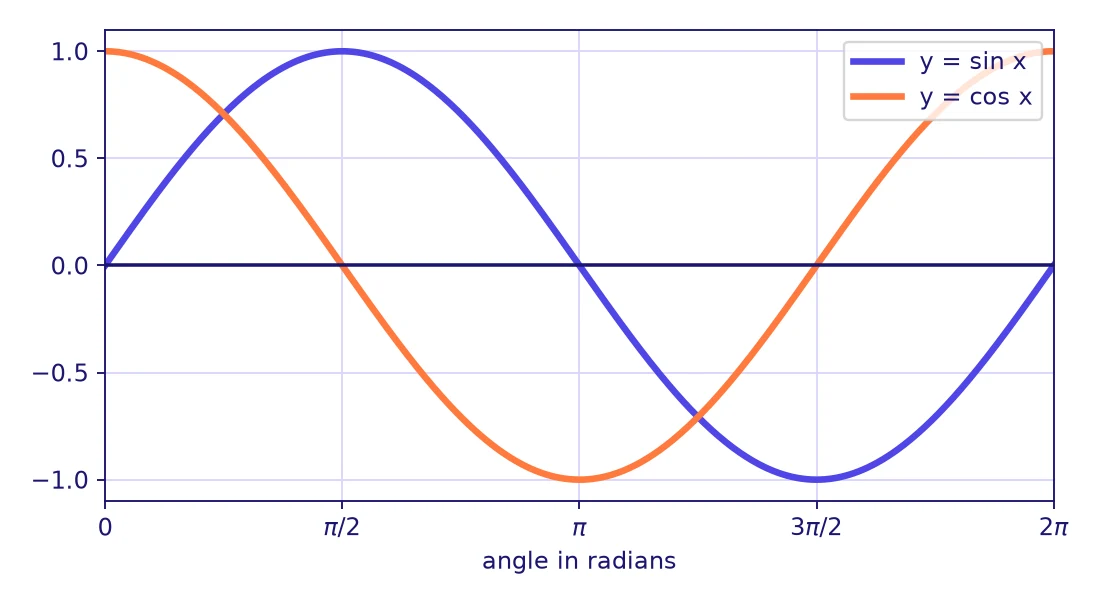
- \(\sin(\theta+2\pi)=\sin\theta\) and \(\cos(\theta+2\pi)=\cos\theta\): period \(2\pi\). Also \(\tan(\theta+\pi)=\tan\theta\): period \(\pi\).
- Cosine is even: \(\cos(-\theta)=\cos\theta\). Sine and tangent are odd: \(\sin(-\theta)=-\sin\theta\), \(\tan(-\theta)=-\tan\theta\).
- \(\sin(\pi-\theta)=\sin\theta\), \(\ \cos(\pi-\theta)=-\cos\theta\), \(\ \sin(\theta+\pi)=-\sin\theta\).
\(\sin\dfrac{19\pi}{6}\): subtract \(2\pi=\dfrac{12\pi}{6}\) to get \(\dfrac{7\pi}{6}\), so the value is \(-\dfrac{1}{2}\). And \(\cos\left(-\dfrac{7\pi}{3}\right)=\cos\dfrac{7\pi}{3}=\cos\dfrac{\pi}{3}=\dfrac{1}{2}\).
7. Angular and linear velocity
An object moving on a circle of radius \(r\) sweeps an angle \(\theta\) in time \(t\). Its angular velocity is \(\omega=\dfrac{\theta}{t}\) (radians per unit of time) and its linear velocity is \(v=\dfrac{s}{t}=r\omega\).
One revolution per minute (rpm) equals \(2\pi\) radians per minute, that is \(\dfrac{\pi}{30}\) radians per second.
A disk of radius \(6\text{ cm}\) spins at \(480\) rpm. Then \(\omega=480\cdot\dfrac{2\pi}{60}=16\pi\approx 50.27\text{ rad/s}\), and the rim moves at \(v=6\cdot16\pi=96\pi\approx 301.6\text{ cm/s}\), or about \(3.02\text{ m/s}\).
Every point of a turning wheel shares the same angular velocity, but points farther from the center travel faster because \(v=r\omega\).
Key takeaways
- \(\pi\) radians \(=180^\circ\); arc length is \(s=r\theta\) and sector area is \(\tfrac{1}{2}r^{2}\theta\) with \(\theta\) in radians.
- The point at angle \(\theta\) on the unit circle is \((\cos\theta,\sin\theta)\), so \(\cos^{2}\theta+\sin^{2}\theta=1\).
- Know the values at \(0,\dfrac{\pi}{6},\dfrac{\pi}{4},\dfrac{\pi}{3},\dfrac{\pi}{2}\); get the others with reference angles and quadrant signs.
- \(\tan=\dfrac{\sin}{\cos}\), and \(\csc,\sec,\cot\) are the reciprocals of \(\sin,\cos,\tan\).
- In a right triangle: SOH-CAH-TOA.
- Sine and cosine have period \(2\pi\); tangent has period \(\pi\). Cosine is even; sine and tangent are odd.
- \(\omega=\dfrac{\theta}{t}\) and \(v=r\omega\); convert rpm with \(1\text{ rpm}=2\pi\text{ rad/min}\).


Test yourself: quick challenge for Grade 12
Speed drill for Grade 12: how many in 60 seconds?
🚀 Keep exploring with Zyro
 ✏️ Math practiceTrigonometric Functions and the Unit Circle: math practice, Grade 12
 📝 Math testsTrigonometric Functions and the Unit Circle: math test, Grade 12
 🎯 Math quizzesTrigonometric Functions and the Unit Circle: math quiz, Grade 12
 ✏️ Math practiceGraphs of Trigonometric Functions: math practice, Grade 12
 ✏️ Math practiceTrigonometric Identities and Equations: math practice, Grade 12
 📝 Math testsGraphs of Trigonometric Functions: math test, Grade 12