



Ocean tides, the sound of a guitar string, the seat of a Ferris wheel, the length of daylight over a year: all of them repeat. In this chapter you learn to draw the graphs of the trigonometric functions, to read every feature of a wave from its equation, and to build an equation from a real situation. Angles are always measured in radians.
1. Graphs of sine and cosine
A function \(f\) is periodic if there is a number \(p>0\) such that \(f(x+p)=f(x)\) for every \(x\) in its domain. The smallest such \(p\) is the period.
The functions \(y=\sin x\) and \(y=\cos x\) are defined for every real number, take every value from \(-1\) to \(1\), and repeat every \(2\pi\). The graph of cosine is the graph of sine slid \(\dfrac{\pi}{2}\) units to the left, because \(\cos x=\sin\left(x+\dfrac{\pi}{2}\right)\).
- Domain: all real numbers. Range: \([-1,1]\). Period: \(2\pi\).
- Sine is odd (symmetric about the origin); cosine is even (symmetric about the \(y\)-axis).
- \(\sin x=0\) at \(x=k\pi\); \(\cos x=0\) at \(x=\dfrac{\pi}{2}+k\pi\), where \(k\) is an integer.
| \(x\) | \(0\) | \(\dfrac{\pi}{2}\) | \(\pi\) | \(\dfrac{3\pi}{2}\) | \(2\pi\) |
|---|---|---|---|---|---|
| \(\sin x\) | \(0\) | \(1\) | \(0\) | \(-1\) | \(0\) |
| \(\cos x\) | \(1\) | \(0\) | \(-1\) | \(0\) | \(1\) |
These five points per cycle are the skeleton of every sine or cosine graph: start, quarter, half, three quarters, end.
2. Amplitude and period
Multiplying changes the wave in two different ways. For \(y=A\sin(Bx)\) or \(y=A\cos(Bx)\):
The amplitude is \(|A|\), half the distance between the maximum and the minimum. The period is \(\dfrac{2\pi}{|B|}\). If \(A<0\), the graph is reflected over the \(x\)-axis.
Graph one cycle of \(y=2\sin(3x)\).
The amplitude is \(2\) and the period is \(\dfrac{2\pi}{3}\). Cut the period into four equal steps of \(\dfrac{\pi}{6}\): the key points are \((0,0)\), \(\left(\dfrac{\pi}{6},2\right)\), \(\left(\dfrac{\pi}{3},0\right)\), \(\left(\dfrac{\pi}{2},-2\right)\) and \(\left(\dfrac{2\pi}{3},0\right)\). Joining them with a smooth wave gives the graph.
- Compute the period and divide it by 4 to get the horizontal step.
- Mark the five \(x\)-values starting from the beginning of a cycle.
- Use the pattern of the parent function (sine: 0, max, 0, min, 0; cosine: max, 0, min, 0, max), scaled by the amplitude and flipped if \(A<0\).
- Connect with a smooth curve and repeat the cycle.
3. Phase shift and vertical shift
The general sinusoidal function is
\[ y=A\sin\big(B(x-C)\big)+D. \]
- \(|A|\): amplitude; \(\dfrac{2\pi}{|B|}\): period.
- \(C\): phase shift, moving the graph right when \(C>0\) and left when \(C<0\).
- \(D\): vertical shift; the midline is \(y=D\), the maximum is \(D+|A|\) and the minimum is \(D-|A|\).
In \(y=3\sin(2x-\tfrac{\pi}{2})+1\) the phase shift is not \(\tfrac{\pi}{2}\). Factor out \(B\): \(2x-\tfrac{\pi}{2}=2\left(x-\tfrac{\pi}{4}\right)\), so the shift is \(\tfrac{\pi}{4}\) to the right.
Analyze \(y=3\sin\left(2x-\dfrac{\pi}{2}\right)+1\).
Rewrite it as \(y=3\sin\left(2\left(x-\dfrac{\pi}{4}\right)\right)+1\). The amplitude is \(3\), the period is \(\pi\), the phase shift is \(\dfrac{\pi}{4}\) to the right, and the midline is \(y=1\) with maximum \(4\) and minimum \(-2\). The cycle starts at \(x=\dfrac{\pi}{4}\) on the midline and the quarter-steps of \(\dfrac{\pi}{4}\) give the points \(\left(\dfrac{\pi}{4},1\right)\), \(\left(\dfrac{\pi}{2},4\right)\), \(\left(\dfrac{3\pi}{4},1\right)\), \((\pi,-2)\) and \(\left(\dfrac{5\pi}{4},1\right)\).
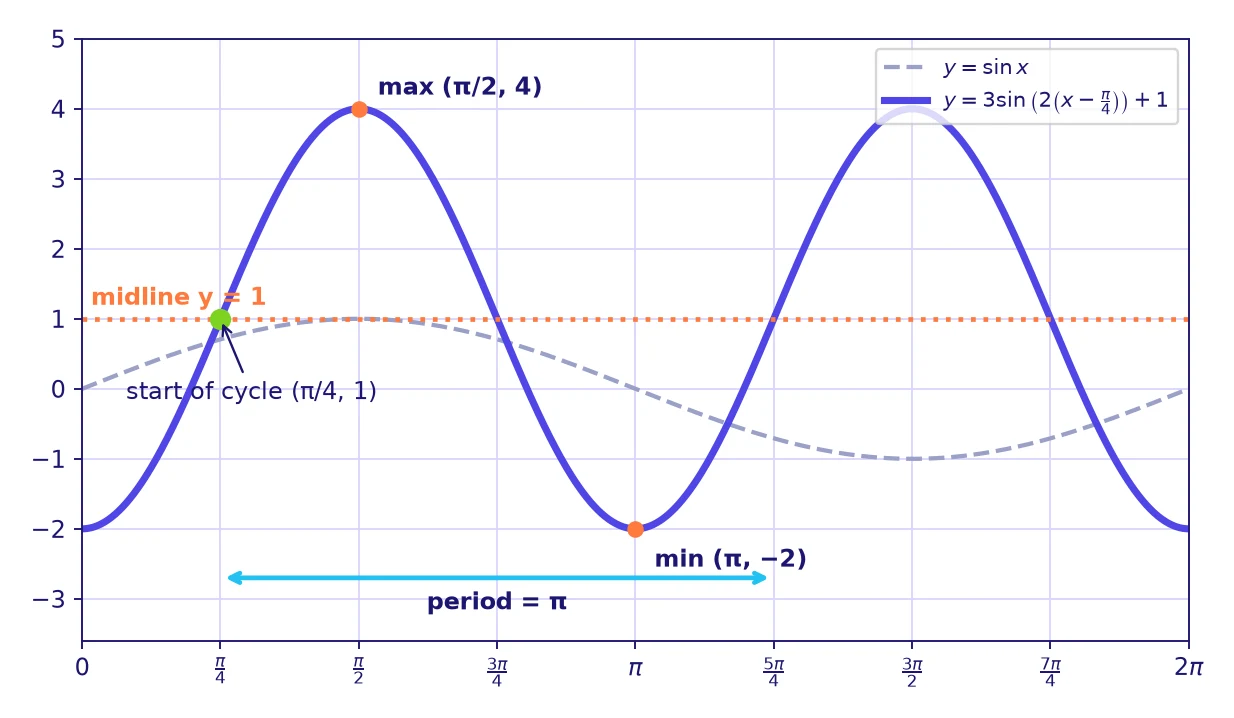
On my planet we say a wave has a “fingerprint”: midline, amplitude, period, start. Find those four things and you can draw the wave with your eyes closed!
4. Graphs of tangent and cotangent
\(\tan x=\dfrac{\sin x}{\cos x}\) and \(\cot x=\dfrac{\cos x}{\sin x}\), defined wherever the denominator is not zero.
- \(y=\tan x\): period \(\pi\); range all real numbers; vertical asymptotes at \(x=\dfrac{\pi}{2}+k\pi\); zeros at \(x=k\pi\); always increasing on each branch.
- \(y=\cot x\): period \(\pi\); range all real numbers; vertical asymptotes at \(x=k\pi\); zeros at \(x=\dfrac{\pi}{2}+k\pi\); always decreasing on each branch.
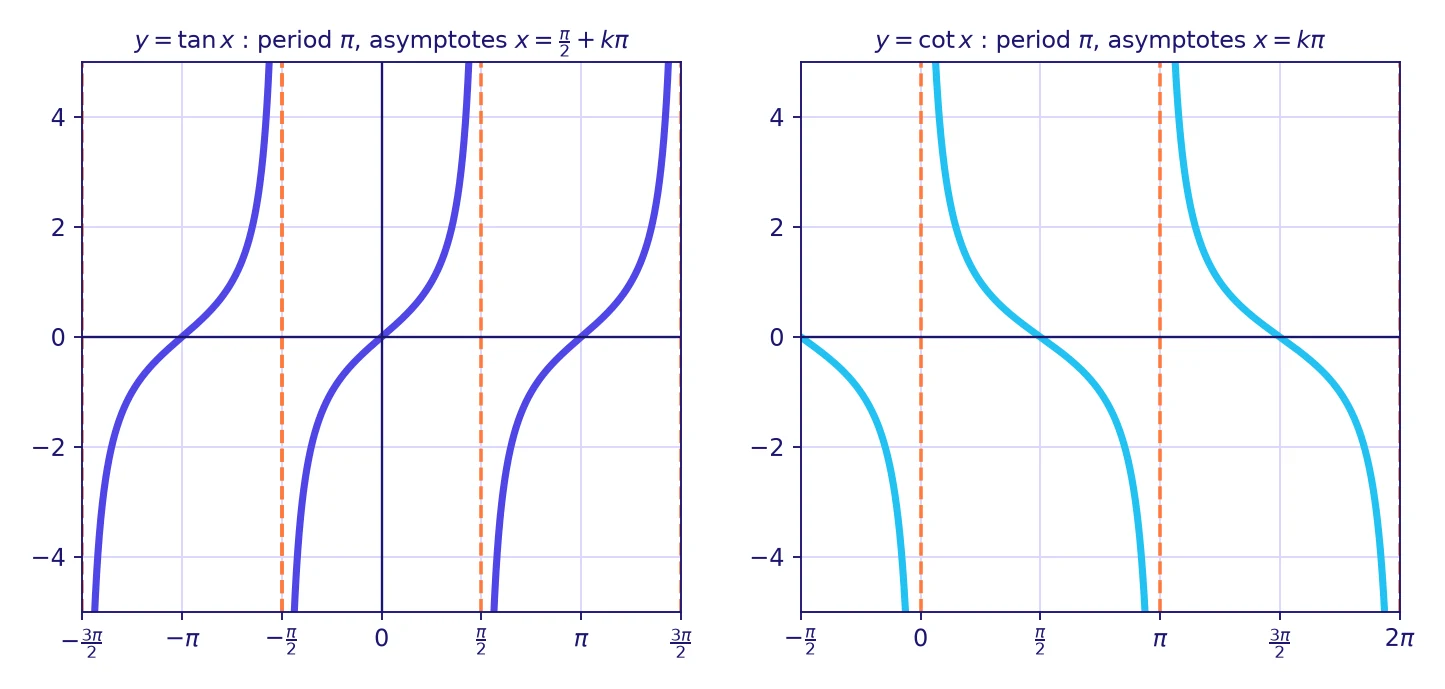
For \(y=A\tan(Bx)\) the period is \(\dfrac{\pi}{|B|}\). Tangent has no maximum, so \(|A|\) is not an amplitude: it stretches the branches vertically.
Describe \(y=\tan(2x)\).
The period is \(\dfrac{\pi}{2}\). The asymptotes solve \(2x=\dfrac{\pi}{2}+k\pi\), that is \(x=\dfrac{\pi}{4}+\dfrac{k\pi}{2}\); the two closest to the origin are \(x=\pm\dfrac{\pi}{4}\). The graph crosses the \(x\)-axis at \(x=0\), and since \(\tan\dfrac{\pi}{4}=1\), it passes through \(\left(\dfrac{\pi}{8},1\right)\) and \(\left(-\dfrac{\pi}{8},-1\right)\).
5. Graphs of secant and cosecant
\(\sec x=\dfrac{1}{\cos x}\) and \(\csc x=\dfrac{1}{\sin x}\). Both have period \(2\pi\).
- Draw the cosine (or sine) curve lightly.
- Draw a vertical asymptote at every zero of that curve.
- Where the curve has a maximum or minimum, draw a U-shaped branch touching it, opening away from the \(x\)-axis.
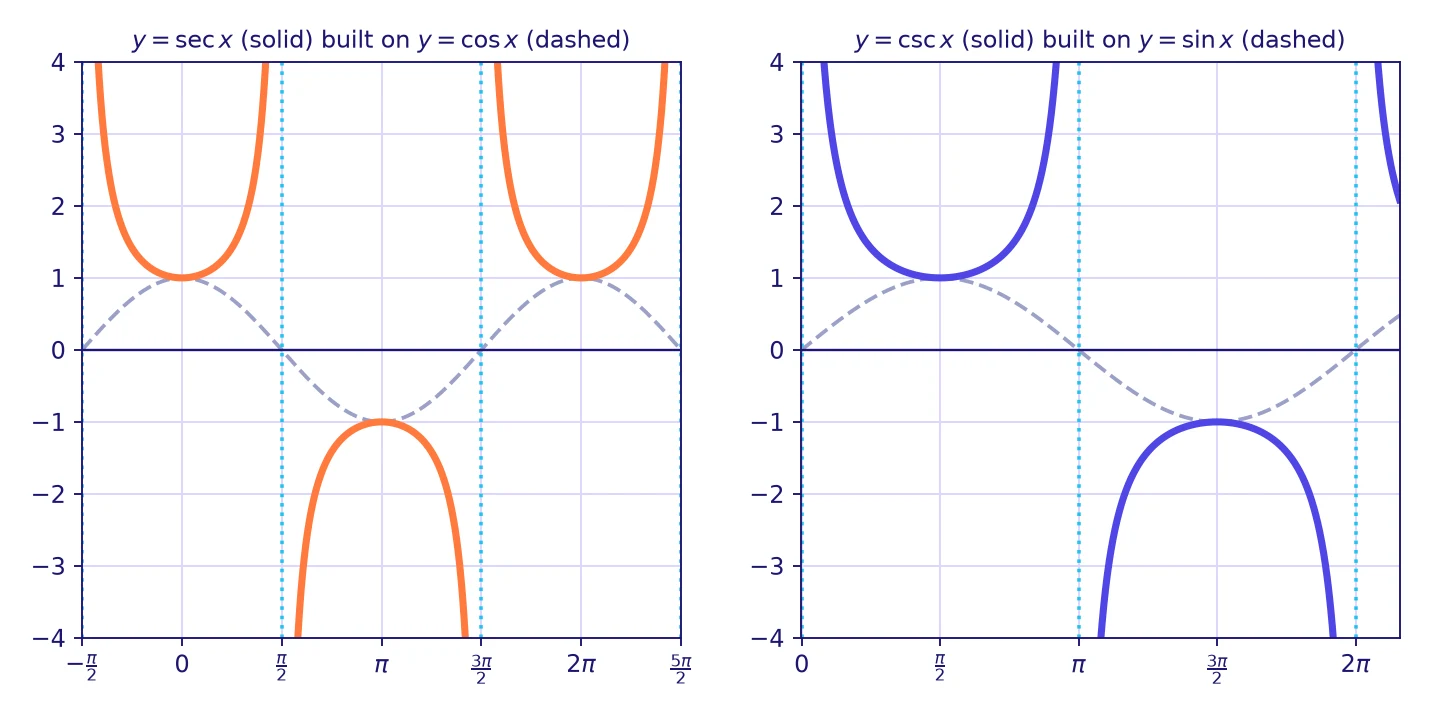
Since \(|\cos x|\le 1\), we get \(|\sec x|\ge 1\): the range of secant and cosecant is \((-\infty,-1]\cup[1,\infty)\). Secant has asymptotes at \(x=\dfrac{\pi}{2}+k\pi\), cosecant at \(x=k\pi\).
6. Inverse trigonometric functions
Sine, cosine and tangent repeat their values, so they are not one-to-one. We restrict each to an interval where it is, and then invert it.
| Function | Domain | Range (output angle) |
|---|---|---|
| \(y=\arcsin x\) | \([-1,1]\) | \(\left[-\dfrac{\pi}{2},\dfrac{\pi}{2}\right]\) |
| \(y=\arccos x\) | \([-1,1]\) | \([0,\pi]\) |
| \(y=\arctan x\) | all real numbers | \(\left(-\dfrac{\pi}{2},\dfrac{\pi}{2}\right)\) |
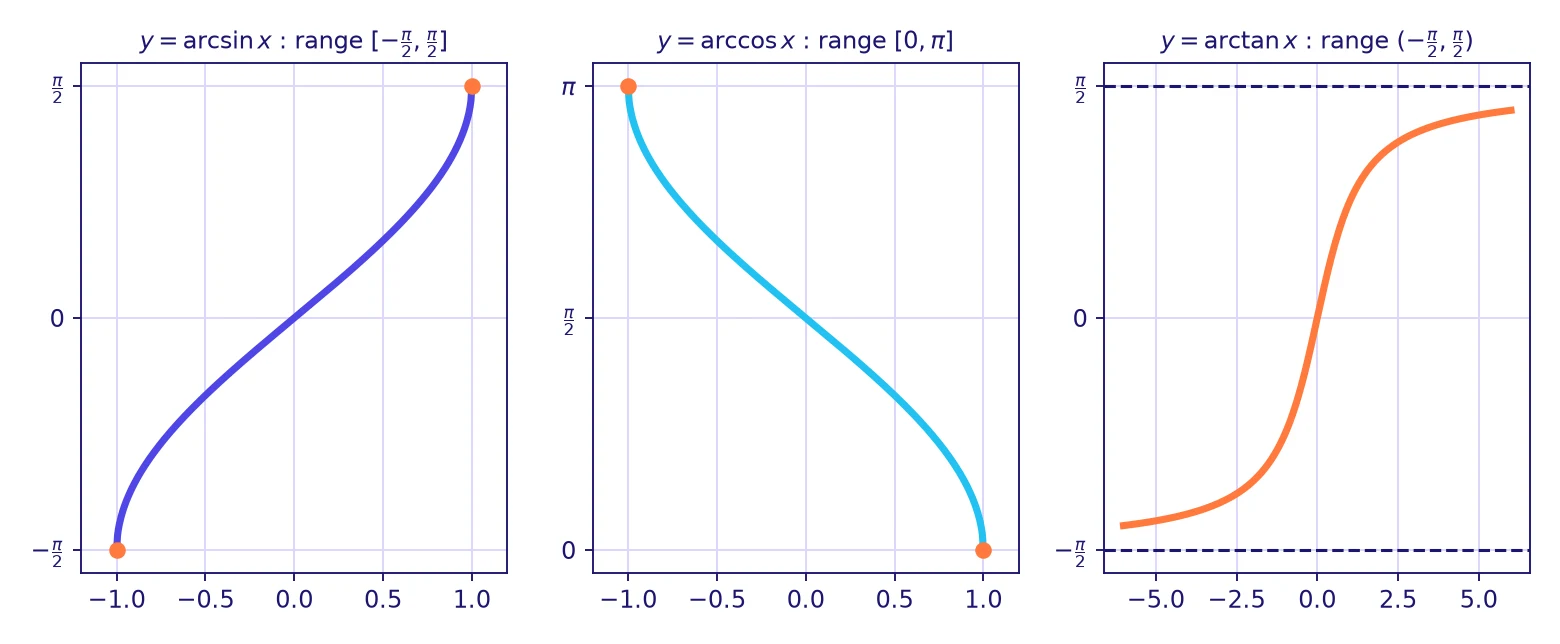
- \(\sin(\arcsin x)=x\) for \(-1\le x\le 1\), but \(\arcsin(\sin x)=x\) only when \(-\dfrac{\pi}{2}\le x\le\dfrac{\pi}{2}\).
- \(\arccos(\cos x)=x\) only when \(0\le x\le\pi\); \(\arctan(\tan x)=x\) only when \(-\dfrac{\pi}{2}<x<\dfrac{\pi}{2}\).
\(\arcsin x\) means “the angle whose sine is \(x\)”. It is not \(\dfrac{1}{\sin x}\), which is \(\csc x\).
(a) \(\arccos\left(\cos\dfrac{5\pi}{4}\right)\): \(\cos\dfrac{5\pi}{4}=-\dfrac{\sqrt2}{2}\), and the angle in \([0,\pi]\) with that cosine is \(\dfrac{3\pi}{4}\). So the answer is \(\dfrac{3\pi}{4}\), not \(\dfrac{5\pi}{4}\).
(b) \(\cos\left(\arcsin\dfrac{3}{5}\right)\): let \(\theta=\arcsin\dfrac{3}{5}\). In a right triangle with opposite side 3 and hypotenuse 5, the adjacent side is 4, so \(\cos\theta=\dfrac{4}{5}\).
7. Modeling periodic phenomena
- Amplitude \(A=\dfrac{\max-\min}{2}\) and midline \(D=\dfrac{\max+\min}{2}\).
- Find the period \(P\) and set \(B=\dfrac{2\pi}{P}\).
- Choose cosine if you know where a maximum or minimum occurs (use \(-\cos\) if time 0 is a minimum), sine if the cycle starts on the midline going up.
- Check the model against one known data point, then answer the question.
A wheel has diameter 80 feet (about 24.4 m), its center is 50 feet (15.2 m) above the ground, and it turns once every 6 minutes. A rider boards at the lowest point.
The minimum is \(50-40=10\) feet, the maximum is \(90\) feet, so \(A=40\) and \(D=50\). The period is 6 minutes, so \(B=\dfrac{2\pi}{6}=\dfrac{\pi}{3}\). Starting at a minimum gives
\[ h(t)=50-40\cos\left(\dfrac{\pi t}{3}\right). \]
Check: \(h(0)=10\). To find when the rider is higher than 70 feet, solve \(50-40\cos\dfrac{\pi t}{3}\ge70\), i.e. \(\cos\dfrac{\pi t}{3}\le-\dfrac12\). On one turn this means \(\dfrac{2\pi}{3}\le\dfrac{\pi t}{3}\le\dfrac{4\pi}{3}\), so \(2\le t\le 4\): two minutes per turn.
Key takeaways
- Sine and cosine have period \(2\pi\), range \([-1,1]\); cosine is sine shifted \(\dfrac{\pi}{2}\) to the left.
- For \(y=A\sin(B(x-C))+D\): amplitude \(|A|\), period \(\dfrac{2\pi}{|B|}\), phase shift \(C\), midline \(y=D\). Always factor \(B\) before reading \(C\).
- Tangent and cotangent have period \(\dfrac{\pi}{|B|}\) after the change \(x\to Bx\), vertical asymptotes, and range all reals.
- Secant and cosecant are reciprocals: asymptotes at the zeros of cosine or sine, range \((-\infty,-1]\cup[1,\infty)\) before stretching.
- Inverse functions need restricted ranges: \(\arcsin\) and \(\arctan\) in \(\left[-\dfrac{\pi}{2},\dfrac{\pi}{2}\right]\), \(\arccos\) in \([0,\pi]\).
- To model a cycle: \(A=\dfrac{\max-\min}{2}\), \(D=\dfrac{\max+\min}{2}\), \(B=\dfrac{2\pi}{\text{period}}\).


Test yourself: quick challenge for Grade 12
Speed drill for Grade 12: how many in 60 seconds?
🚀 Keep exploring with Zyro
 ✏️ Math practiceGraphs of Trigonometric Functions: math practice, Grade 12
 📝 Math testsGraphs of Trigonometric Functions: math test, Grade 12
 🎯 Math quizzesGraphs of Trigonometric Functions: math quiz, Grade 12
 ✏️ Math practiceTrigonometric Identities and Equations: math practice, Grade 12
 ✏️ Math practiceLaw of Sines and Law of Cosines: math practice, Grade 12
 📝 Math testsTrigonometric Identities and Equations: math test, Grade 12