



Ocean tides, sound waves, the swing of a pendulum and the height of a seat on a Ferris wheel all repeat in a regular pattern. Trigonometric functions are the mathematical tool for describing that repetition. In this chapter you will measure angles in radians, learn to read the unit circle, graph sine, cosine and tangent, solve trigonometric equations and build your own models of periodic phenomena.
1. Radian measure and converting between degrees and radians
Degrees cut a full turn into 360 equal pieces, a choice that comes from history rather than from mathematics. A radian lets the circle itself set the unit.
One radian is the measure of a central angle that cuts off an arc whose length equals the radius of the circle. Because the circumference is \(2\pi r\), a full turn measures \(\dfrac{2\pi r}{r}=2\pi\) radians.
So \(360^\circ = 2\pi\) radians and \(180^\circ = \pi\) radians. This single fact gives both conversion rules. When the angle \(\theta\) is in radians, the arc length is simply \(s = r\theta\).
Degrees to radians: multiply by \(\dfrac{\pi}{180}\). Radians to degrees: multiply by \(\dfrac{180}{\pi}\).
| Degrees | Radians | Degrees | Radians |
|---|---|---|---|
| \(0^\circ\) | \(0\) | \(135^\circ\) | \(\dfrac{3\pi}{4}\) |
| \(30^\circ\) | \(\dfrac{\pi}{6}\) | \(150^\circ\) | \(\dfrac{5\pi}{6}\) |
| \(45^\circ\) | \(\dfrac{\pi}{4}\) | \(180^\circ\) | \(\pi\) |
| \(60^\circ\) | \(\dfrac{\pi}{3}\) | \(270^\circ\) | \(\dfrac{3\pi}{2}\) |
| \(90^\circ\) | \(\dfrac{\pi}{2}\) | \(360^\circ\) | \(2\pi\) |
| \(120^\circ\) | \(\dfrac{2\pi}{3}\) | \(-90^\circ\) | \(-\dfrac{\pi}{2}\) |
(a) \(135^\circ = 135\times\dfrac{\pi}{180}=\dfrac{3\pi}{4}\) radians.
(b) \(\dfrac{7\pi}{6}\) radians \(=\dfrac{7\pi}{6}\times\dfrac{180}{\pi}=210^\circ\).
(c) A bicycle wheel of radius 14 inches turns through \(\dfrac{2\pi}{3}\) radians. The arc length is \(s=14\times\dfrac{2\pi}{3}=\dfrac{28\pi}{3}\approx 29.3\) inches, which is about 74.5 centimeters.
The formula \(s=r\theta\) works only when \(\theta\) is in radians. If an angle is given in degrees, convert it first.
2. The unit circle and exact values of sine, cosine and tangent
The unit circle is the circle of radius 1 centered at the origin. Start at the point \((1,0)\) and move counterclockwise along the circle through a signed angle \(\theta\). The point where you stop is \((\cos\theta,\ \sin\theta)\). The tangent is \(\tan\theta=\dfrac{\sin\theta}{\cos\theta}\), defined whenever \(\cos\theta\ne 0\).
The coordinates of the first-quadrant points come from two special triangles: the \(45^\circ\)-\(45^\circ\)-\(90^\circ\) triangle and the \(30^\circ\)-\(60^\circ\)-\(90^\circ\) triangle. They give the values you should know by heart.
| \(\theta\) | \(0\) | \(\dfrac{\pi}{6}\) | \(\dfrac{\pi}{4}\) | \(\dfrac{\pi}{3}\) | \(\dfrac{\pi}{2}\) |
|---|---|---|---|---|---|
| \(\sin\theta\) | \(0\) | \(\dfrac{1}{2}\) | \(\dfrac{\sqrt{2}}{2}\) | \(\dfrac{\sqrt{3}}{2}\) | \(1\) |
| \(\cos\theta\) | \(1\) | \(\dfrac{\sqrt{3}}{2}\) | \(\dfrac{\sqrt{2}}{2}\) | \(\dfrac{1}{2}\) | \(0\) |
| \(\tan\theta\) | \(0\) | \(\dfrac{\sqrt{3}}{3}\) | \(1\) | \(\sqrt{3}\) | undefined |
For the sine of \(0,\ \dfrac{\pi}{6},\ \dfrac{\pi}{4},\ \dfrac{\pi}{3},\ \dfrac{\pi}{2}\), count the numbers \(\dfrac{\sqrt{0}}{2},\dfrac{\sqrt{1}}{2},\dfrac{\sqrt{2}}{2},\dfrac{\sqrt{3}}{2},\dfrac{\sqrt{4}}{2}\). Cosine uses the same list in reverse order.
The point for \(\theta=\dfrac{\pi}{3}\) is \(\left(\dfrac{1}{2},\dfrac{\sqrt{3}}{2}\right)\), so \(\cos\dfrac{\pi}{3}=\dfrac{1}{2}\) and \(\tan\dfrac{\pi}{3}=\dfrac{\sqrt{3}/2}{1/2}=\sqrt{3}\). At \(\theta=\pi\) the point is \((-1,0)\), so \(\sin\pi=0\) and \(\cos\pi=-1\).
3. Reference angles and signs by quadrant
Every angle can be handled with the first-quadrant values. The reference angle of \(\theta\) is the acute angle between the terminal side of \(\theta\) and the x-axis. Angles that differ by a multiple of \(2\pi\) end at the same point, so they have the same trigonometric values.
| Quadrant | Angle \(\theta\) | \(\sin\theta\) | \(\cos\theta\) | \(\tan\theta\) | Reference angle |
|---|---|---|---|---|---|
| I | \(0<\theta<\dfrac{\pi}{2}\) | + | + | + | \(\theta\) |
| II | \(\dfrac{\pi}{2}<\theta<\pi\) | + | − | − | \(\pi-\theta\) |
| III | \(\pi<\theta<\dfrac{3\pi}{2}\) | − | − | + | \(\theta-\pi\) |
| IV | \(\dfrac{3\pi}{2}<\theta<2\pi\) | − | + | − | \(2\pi-\theta\) |
- Find the quadrant of the terminal side (subtract \(2\pi\) if the angle is larger than a full turn).
- Compute the reference angle with the table above.
- Write the sine, cosine or tangent of the reference angle.
- Attach the sign that the quadrant gives to that function.
Find \(\cos\dfrac{7\pi}{6}\) and \(\tan\dfrac{5\pi}{3}\).
\(\dfrac{7\pi}{6}\) lies in quadrant III, its reference angle is \(\dfrac{7\pi}{6}-\pi=\dfrac{\pi}{6}\), and cosine is negative there. So \(\cos\dfrac{7\pi}{6}=-\dfrac{\sqrt{3}}{2}\).
\(\dfrac{5\pi}{3}\) lies in quadrant IV, the reference angle is \(2\pi-\dfrac{5\pi}{3}=\dfrac{\pi}{3}\), and tangent is negative there. So \(\tan\dfrac{5\pi}{3}=-\sqrt{3}\).
4. The Pythagorean identity
Every point \((x,y)\) of the unit circle satisfies \(x^2+y^2=1\). Since \(x=\cos\theta\) and \(y=\sin\theta\), we get the fundamental identity.
For every real number \(\theta\): \(\sin^2\theta+\cos^2\theta=1\).
It lets you find one function when you know another and the quadrant. The quadrant decides which sign of the square root to keep.
Suppose \(\cos\theta=\dfrac{4}{5}\) and \(\theta\) is in quadrant IV. Then \(\sin^2\theta=1-\dfrac{16}{25}=\dfrac{9}{25}\), so \(\sin\theta=\pm\dfrac{3}{5}\). Sine is negative in quadrant IV, so \(\sin\theta=-\dfrac{3}{5}\) and \(\tan\theta=\dfrac{-3/5}{4/5}=-\dfrac{3}{4}\).
5. Graphs of sine and cosine
Unwrapping the unit circle onto a number line gives the graphs below. As \(\theta\) goes once around the circle, the height \(\sin\theta\) rises from 0 to 1, falls to \(-1\) and returns to 0. The pattern then repeats forever.
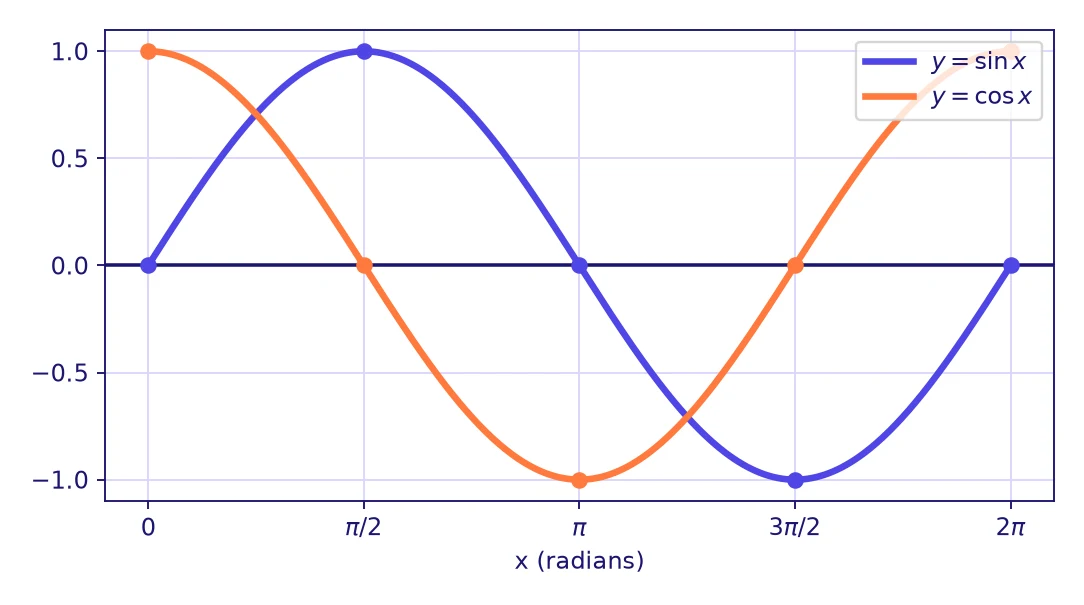
Domain: all real numbers. Range: \([-1,1]\). Period: \(2\pi\). The sine graph passes through the origin and is symmetric about it (an odd function); the cosine graph crosses the y-axis at 1 and is symmetric about the y-axis (an even function). Each graph is described by five key points per period, spaced a quarter period apart.
6. Amplitude, period, phase shift and vertical shift
The general sinusoidal function has the form \(y=A\sin\big(B(x-C)\big)+D\), and the same pattern holds for cosine. Each letter transforms the basic graph.
Amplitude \(|A|\): half the distance between the maximum and the minimum. Period \(\dfrac{2\pi}{|B|}\): the length of one full cycle. Phase shift \(C\): a move of \(C\) units to the right (to the left if \(C<0\)). Vertical shift \(D\): the midline is \(y=D\), so the maximum is \(D+|A|\) and the minimum is \(D-|A|\). A negative \(A\) reflects the graph over the midline.
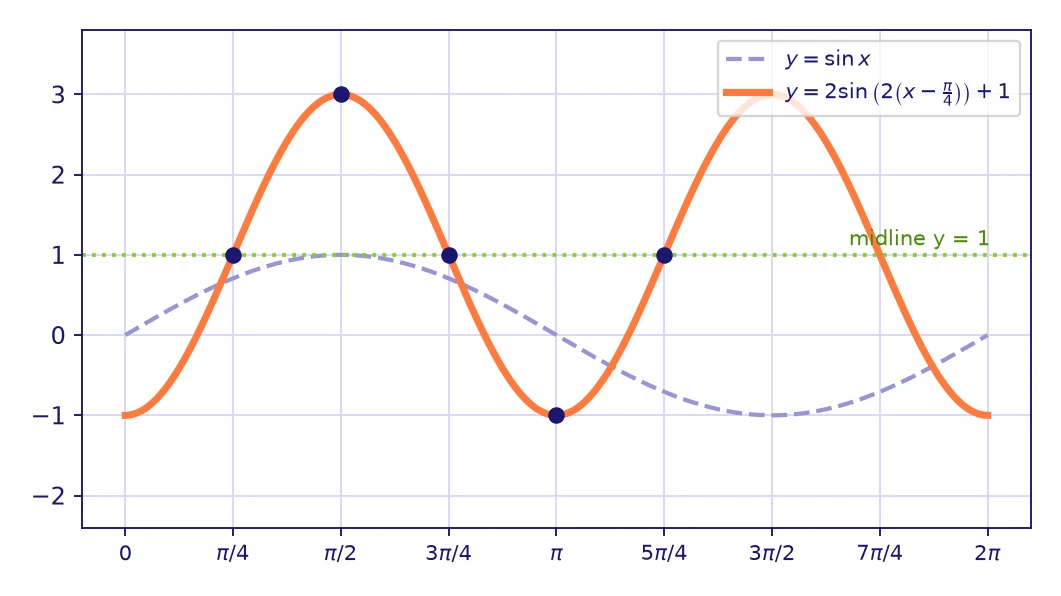
Graph \(y=2\sin\left(2\left(x-\dfrac{\pi}{4}\right)\right)+1\).
Amplitude 2, period \(\dfrac{2\pi}{2}=\pi\), phase shift \(\dfrac{\pi}{4}\) to the right, midline \(y=1\). So the maximum is 3 and the minimum is \(-1\). A cycle begins at \(x=\dfrac{\pi}{4}\) on the midline, then the quarter-period steps of \(\dfrac{\pi}{4}\) give: maximum at \(\dfrac{\pi}{2}\), midline at \(\dfrac{3\pi}{4}\), minimum at \(\pi\), midline at \(\dfrac{5\pi}{4}\).
In \(y=\sin(2x-\pi)\), the shift is not \(\pi\). Factor out the 2: \(\sin\big(2(x-\tfrac{\pi}{2})\big)\), so the shift is \(\dfrac{\pi}{2}\).
7. The graph of tangent and its asymptotes
Since \(\tan x=\dfrac{\sin x}{\cos x}\), the tangent is undefined wherever \(\cos x=0\), that is, at \(x=\dfrac{\pi}{2}+k\pi\) for any integer \(k\). Near those values the graph shoots toward \(\pm\infty\), so each one gives a vertical asymptote.
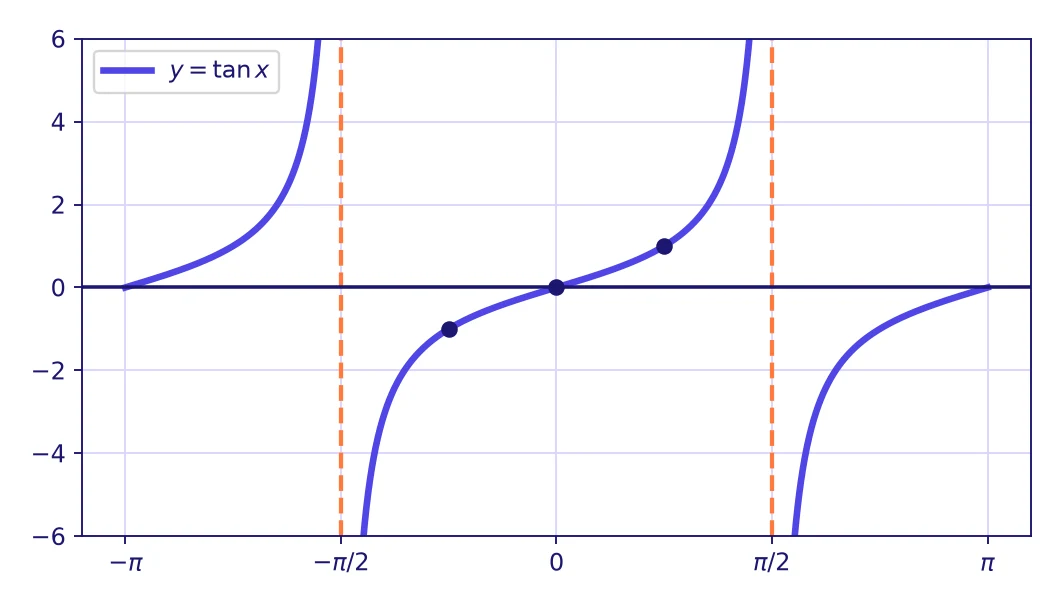
The period is \(\pi\), the range is all real numbers (there is no amplitude), the zeros are \(x=k\pi\), and the graph is increasing on each branch. For \(y=\tan(Bx)\) the period is \(\dfrac{\pi}{|B|}\) and the asymptotes are at \(x=\dfrac{\pi}{2|B|}+\dfrac{k\pi}{|B|}\).
8. Solving basic trigonometric equations
- Isolate the trigonometric expression, for example \(\sin x=\dfrac{1}{2}\).
- Find the reference angle from the exact values table.
- Use the sign of the value to choose the quadrants, then list every solution in the interval.
- For all real solutions, add the period: \(2k\pi\) for sine and cosine, \(k\pi\) for tangent.
(a) \(\sin x=-\dfrac{\sqrt{2}}{2}\) on \([0,2\pi)\): the reference angle is \(\dfrac{\pi}{4}\) and sine is negative in quadrants III and IV, so \(x=\dfrac{5\pi}{4}\) or \(x=\dfrac{7\pi}{4}\).
(b) \(\tan x=1\) on \([0,2\pi)\): \(x=\dfrac{\pi}{4}\) or \(x=\dfrac{5\pi}{4}\); all real solutions are \(x=\dfrac{\pi}{4}+k\pi\).
(c) \(2\sin^2x-\sin x=0\): factor to \(\sin x\,(2\sin x-1)=0\). Then \(\sin x=0\) gives \(x=0,\ \pi\) and \(\sin x=\dfrac{1}{2}\) gives \(x=\dfrac{\pi}{6},\ \dfrac{5\pi}{6}\).
Never divide both sides by \(\sin x\) in part (c): you would lose the solutions where \(\sin x=0\). Factor instead. Also remember that an equation like \(\sin x=\dfrac{1}{2}\) has two solutions per period, not one.
9. Modeling periodic phenomena
When data repeat smoothly, a sinusoid \(y=A\cos\big(B(t-C)\big)+D\) is a good model. Read the parameters directly from the situation.
- Amplitude: \(A=\dfrac{\text{max}-\text{min}}{2}\). Midline: \(D=\dfrac{\text{max}+\text{min}}{2}\).
- Period \(P\): then \(B=\dfrac{2\pi}{P}\).
- Choose cosine for a maximum at the start (or \(-\cos\) for a minimum at the start), then use the shift \(C\) if the cycle begins later.
- Check the model against two known data points.
The pedal of a bike is 4 inches above the ground at its lowest point and 18 inches at its highest. The crank makes one full turn every 2 seconds, starting at the lowest point at \(t=0\). The amplitude is \(\dfrac{18-4}{2}=7\), the midline is \(\dfrac{18+4}{2}=11\), and \(B=\dfrac{2\pi}{2}=\pi\). Starting at a minimum means a reflected cosine: \(h(t)=11-7\cos(\pi t)\). Check: \(h(0)=4\) and \(h(1)=18\). At \(t=0.5\) second, \(h=11\) inches, which is about 28 centimeters.
Key takeaways
- \(180^\circ=\pi\) radians; convert with the factors \(\dfrac{\pi}{180}\) and \(\dfrac{180}{\pi}\). Arc length is \(s=r\theta\) with \(\theta\) in radians.
- On the unit circle, the point at angle \(\theta\) is \((\cos\theta,\sin\theta)\) and \(\tan\theta=\dfrac{\sin\theta}{\cos\theta}\).
- Use the reference angle and the quadrant sign to get exact values; learn the table for \(0,\dfrac{\pi}{6},\dfrac{\pi}{4},\dfrac{\pi}{3},\dfrac{\pi}{2}\).
- \(\sin^2\theta+\cos^2\theta=1\) for every angle.
- For \(y=A\sin\big(B(x-C)\big)+D\): amplitude \(|A|\), period \(\dfrac{2\pi}{|B|}\), phase shift \(C\), midline \(y=D\).
- \(\tan x\) has period \(\pi\), zeros at \(k\pi\), and asymptotes at \(\dfrac{\pi}{2}+k\pi\).
- To solve an equation, find the reference angle, use the quadrants, list solutions in the interval, then add periods; factor instead of dividing.
- To model, take \(A\) from the max and min, \(D\) as their average and \(B=\dfrac{2\pi}{\text{period}}\).


Test yourself: quick challenge for Grade 11
Speed drill for Grade 11: how many in 60 seconds?
🚀 Keep exploring with Zyro
 ✏️ Math practiceTrigonometric Functions and the Unit Circle: math practice, Grade 11
 📝 Math testsTrigonometric Functions and the Unit Circle: math test, Grade 11
 🎯 Math quizzesTrigonometric Functions and the Unit Circle: math quiz, Grade 11
 ✏️ Math practiceProbability and Statistics: math practice, Grade 11
 ✏️ Math practiceLinear Equations, Inequalities and Systems: math practice, Grade 11
 📝 Math testsProbability and Statistics: math test, Grade 11