


Slice a cone with a flat plane and four famous curves appear: circles, ellipses, parabolas and hyperbolas. In Grade 12 you will describe each one with an equation, find its key points, measure how “stretched” it is with eccentricity, and then draw curves in a new way, with a parameter that moves a point along the path.
1. Where conic sections come from
Take a double cone. A plane that cuts straight across (perpendicular to the axis) gives a circle. Tilt the plane a little and you get an ellipse. Tilt it until it is parallel to the side of the cone and you get a parabola. Tilt it even more so that it cuts both halves of the cone and you get a hyperbola with two branches.
Every conic can also be defined by distances in the coordinate plane, and that is the definition we use to build equations.
2. Circles and general form
A circle is the set of all points at a fixed distance \(r\) (the radius) from a fixed point \((h, k)\) (the center). Its standard form is
\[(x-h)^2+(y-k)^2=r^2.\]
Expanding the squares gives the general form \(x^2+y^2+Dx+Ey+F=0\). To go back to the standard form you complete the square in \(x\) and in \(y\).
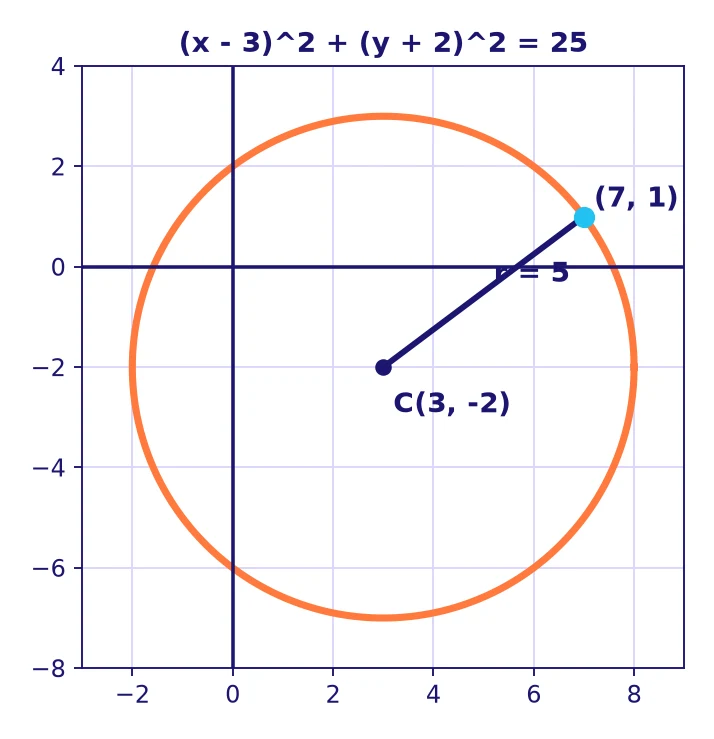
Find the center and radius of \(x^2+y^2-6x+4y-12=0\).
Group terms: \((x^2-6x)+(y^2+4y)=12\). Add \(9\) and \(4\) to both sides: \((x-3)^2+(y+2)^2=25\). The center is \((3,-2)\) and the radius is \(5\).
3. Parabolas
A parabola is the set of points that are the same distance from a fixed point, the focus, and from a fixed line, the directrix. The point halfway between them is the vertex.
Opens up or down: \((x-h)^2=4p(y-k)\), focus \((h,k+p)\), directrix \(y=k-p\).
Opens right or left: \((y-k)^2=4p(x-h)\), focus \((h+p,k)\), directrix \(x=h-p\).
If \(p>0\) it opens up (or right); if \(p<0\) it opens down (or left).
For \(x^2=12y\): \(4p=12\), so \(p=3\). The vertex is \((0,0)\), the focus is \((0,3)\) and the directrix is \(y=-3\). The point \(P(6,3)\) is on the curve because \(6^2=12\cdot 3\); its distance to the focus is \(6\) and its distance to the directrix is \(3-(-3)=6\).
On Earth I noticed that satellite dishes are parabolas. Every incoming signal bounces to the focus, so the receiver sits exactly there.
4. Ellipses
An ellipse is the set of points whose distances to two fixed points, the foci, have a constant sum \(2a\).
\[\dfrac{x^2}{a^2}+\dfrac{y^2}{b^2}=1\] has vertices \((\pm a,0)\), co-vertices \((0,\pm b)\) and foci \((\pm c,0)\) where \(c^2=a^2-b^2\). If the larger denominator sits under \(y^2\), the long axis is vertical. With center \((h,k)\), replace \(x\) by \(x-h\) and \(y\) by \(y-k\).
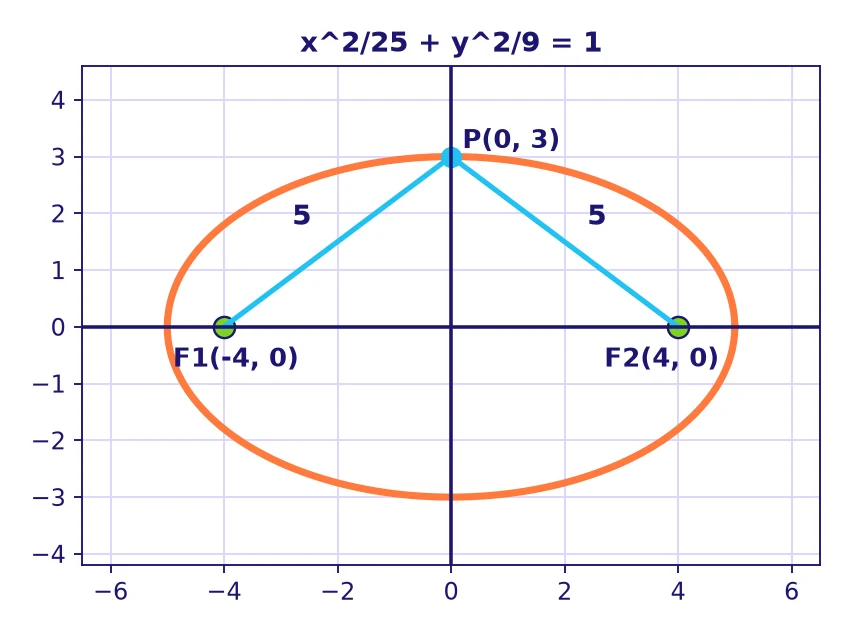
For \(\dfrac{x^2}{25}+\dfrac{y^2}{9}=1\): \(a=5\), \(b=3\), \(c=\sqrt{25-9}=4\). Vertices \((\pm5,0)\), co-vertices \((0,\pm3)\), foci \((\pm4,0)\). Check with \(P(0,3)\): its distance to each focus is \(\sqrt{16+9}=5\), and \(5+5=10=2a\).
5. Hyperbolas
A hyperbola is the set of points for which the difference of the distances to two foci is constant, equal to \(2a\) in absolute value.
\[\dfrac{x^2}{a^2}-\dfrac{y^2}{b^2}=1\] has vertices \((\pm a,0)\), foci \((\pm c,0)\) with \(c^2=a^2+b^2\), and asymptotes \(y=\pm\dfrac{b}{a}x\). For \(\dfrac{y^2}{a^2}-\dfrac{x^2}{b^2}=1\) the branches open up and down, and the asymptotes are \(y=\pm\dfrac{a}{b}x\).
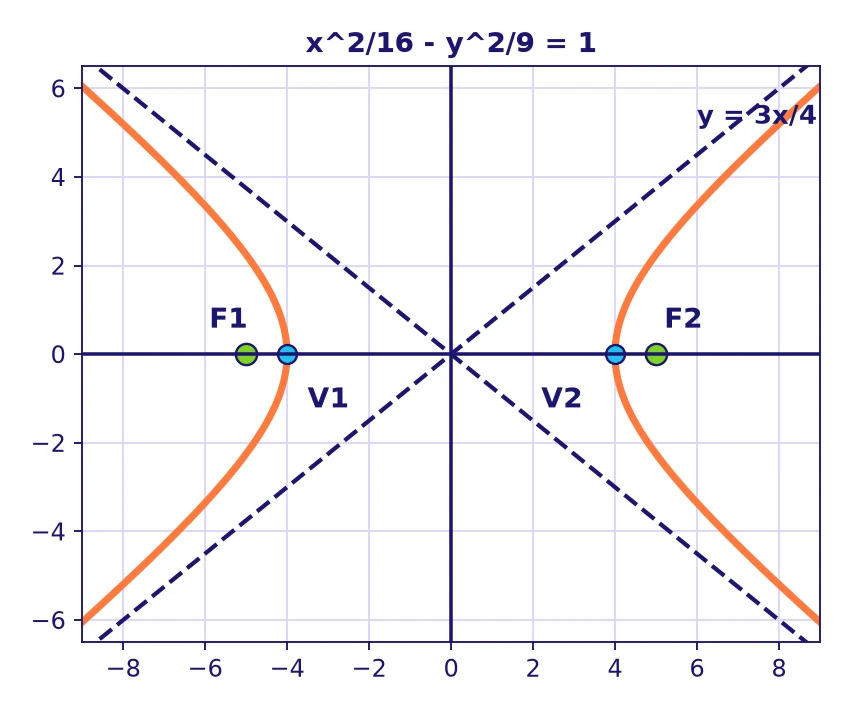
For \(\dfrac{x^2}{16}-\dfrac{y^2}{9}=1\): \(a=4\), \(b=3\), \(c=\sqrt{16+9}=5\). Vertices \((\pm4,0)\), foci \((\pm5,0)\), asymptotes \(y=\pm\dfrac{3}{4}x\).
For an ellipse \(c^2=a^2-b^2\), but for a hyperbola \(c^2=a^2+b^2\). Also, in a hyperbola \(a\) is not necessarily the larger number: it is the one under the positive term.
6. Eccentricity
For an ellipse or a hyperbola, the eccentricity is \(e=\dfrac{c}{a}\). It measures how far the foci are from the center compared with the size of the curve.
| Conic | Eccentricity | Shape |
|---|---|---|
| Circle | \(e=0\) | foci merge into the center |
| Ellipse | \(0| closed oval, flatter as \(e\) grows |
|
| Parabola | \(e=1\) | one open branch |
| Hyperbola | \(e>1\) | two open branches |
For \(\dfrac{x^2}{25}+\dfrac{y^2}{9}=1\), \(e=\dfrac{4}{5}=0.8\) (fairly stretched). For \(\dfrac{x^2}{16}-\dfrac{y^2}{9}=1\), \(e=\dfrac{5}{4}=1.25\).
7. Parametric equations
A curve can be given by \(x=f(t)\) and \(y=g(t)\), where the parameter \(t\) (often time or an angle) runs over an interval. Each value of \(t\) gives one point \((x,y)\), and the curve shows the path and the direction of motion.
Circle: \(x=h+r\cos t,\ y=k+r\sin t\). Ellipse: \(x=h+a\cos t,\ y=k+b\sin t\). Hyperbola: \(x=a\sec t,\ y=b\tan t\).
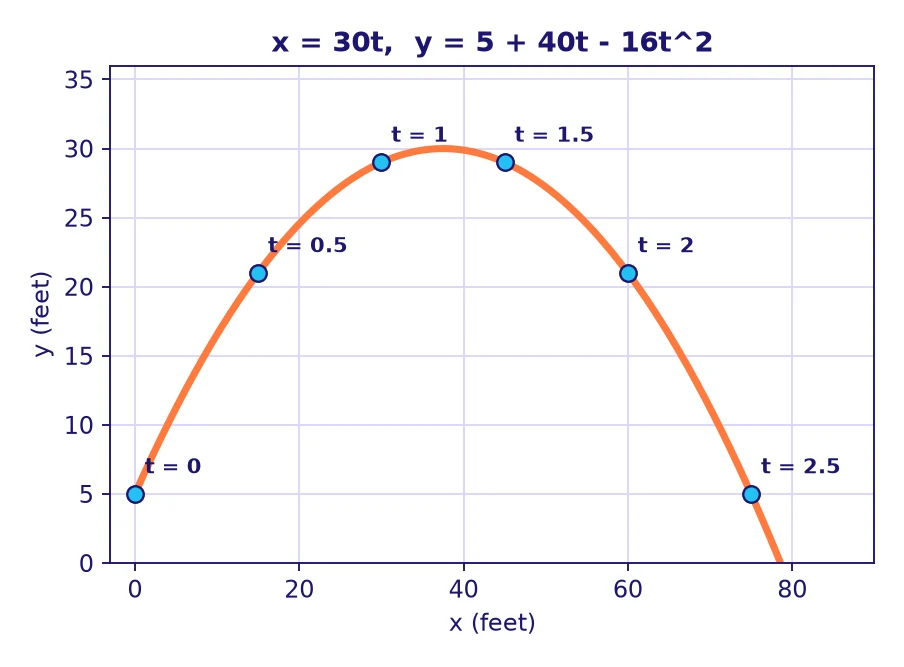
A ball follows \(x=30t,\ y=5+40t-16t^2\) (feet, seconds). At \(t=1\): \((30,29)\). The height is largest when \(t=\dfrac{40}{32}=1.25\) s, where \(y=5+50-25=30\) ft (about 9.1 m).
8. Eliminating the parameter
- If one equation is easy to solve for \(t\), solve it and substitute into the other.
- If the equations use \(\cos t\) and \(\sin t\) (or \(\sec t\) and \(\tan t\)), isolate those functions and use \(\cos^2t+\sin^2t=1\) (or \(\sec^2t-\tan^2t=1\)).
- Look at the range of \(t\): it may restrict which part of the curve is drawn.
\(x=2t+1,\ y=t^2-3\). Then \(t=\dfrac{x-1}{2}\), so \(y=\dfrac{(x-1)^2}{4}-3\), a parabola opening upward with vertex \((1,-3)\).
\(x=3\cos t,\ y=2\sin t\). Then \(\cos t=\dfrac{x}{3}\) and \(\sin t=\dfrac{y}{2}\), so \(\dfrac{x^2}{9}+\dfrac{y^2}{4}=1\), an ellipse traced once as \(t\) goes from \(0\) to \(2\pi\).
\(x=\cos t,\ y=\sin^2 t\) gives \(y=1-x^2\), but only for \(-1\le x\le1\): the curve is an arc, not the whole parabola.
Key takeaways
- Circle: \((x-h)^2+(y-k)^2=r^2\); complete the square to find the center and radius.
- Parabola: \((x-h)^2=4p(y-k)\) or \((y-k)^2=4p(x-h)\); focus at distance \(|p|\) from the vertex, directrix on the other side.
- Ellipse: \(c^2=a^2-b^2\); hyperbola: \(c^2=a^2+b^2\) with asymptotes \(y=\pm\frac{b}{a}x\).
- Eccentricity \(e=c/a\): \(0\) for a circle, \(<1\) ellipse, \(1\) parabola, \(>1\) hyperbola.
- Parametric equations give a point for each \(t\); eliminate \(t\) by substitution or by an identity, and check the domain.


Test yourself: quick challenge for Grade 12
Speed drill for Grade 12: how many in 60 seconds?
🚀 Keep exploring with Zyro
 ✏️ Math practiceConic Sections and Parametric Equations: math practice, Grade 12
 📝 Math testsConic Sections and Parametric Equations: math test, Grade 12
 🎯 Math quizzesConic Sections and Parametric Equations: math quiz, Grade 12
 ✏️ Math practiceMatrices and Systems of Equations: math practice, Grade 12
 ✏️ Math practiceSequences, Series, and Induction: math practice, Grade 12
 📝 Math testsMatrices and Systems of Equations: math test, Grade 12